by Redazione
This is no longer a sectarian or regional issue—it has become a broader existential crisis. The Druze, especially in Syria, cannot freely determine their future due to the urgent and numerous threats they face. It is therefore the responsibility of the Syrian state—if it seeks to preserve national unity—to restore the community’s dignity, ensure its safety, uphold equal citizenship, and protect it from the harmful forces of political and security exploitation.
By Dr. Nidal Shoukeir
Professor of Strategic Communications and Governmental Relations
 Once again, Druze areas in Syria are witnessing bloody, sectarian-motivated events that reopen old wounds and push members of the Druze community to revisit the annals of history in search of lost formulas—formulas that could preserve what remains of their presence and help them reprioritize during a critical juncture in their history, and in the region’s history at large.
A Renewed Threat and the Druze Existential Question
Following the attacks on Jaramana in March and April, the city of Suwayda and its surroundings witnessed new assaults carried out by members of Bedouin tribes—reports even suggested participation by elements from Syria’s Ministry of Defense and Ministry of Interior. These recurring assaults since the beginning of the year are no longer isolated security incidents. Instead, they reflect a deliberate and systematic pattern of pressure and threats aimed at the Druze entity in Syria, through both intimidation and the undermining of its social and political infrastructure.
Ultimately, the events in Suwayda throw wide open the gates of existential anxiety—not only for Syria’s Druze, but for Druze communities across the Levant—raising a pivotal question: What future awaits the Druze in the region?
Druze of the Levant: A Historic Presence in Contemporary Decline
For those unfamiliar, the Druze have been an integral part of the Levantine fabric for nearly a thousand years, playing key roles in its political and social structures. From the Fatimid era through the Mamluk and Ottoman periods to the modern age, the Druze have left a distinct mark on the region’s history—particularly in Syria, Lebanon, and even in Israel.
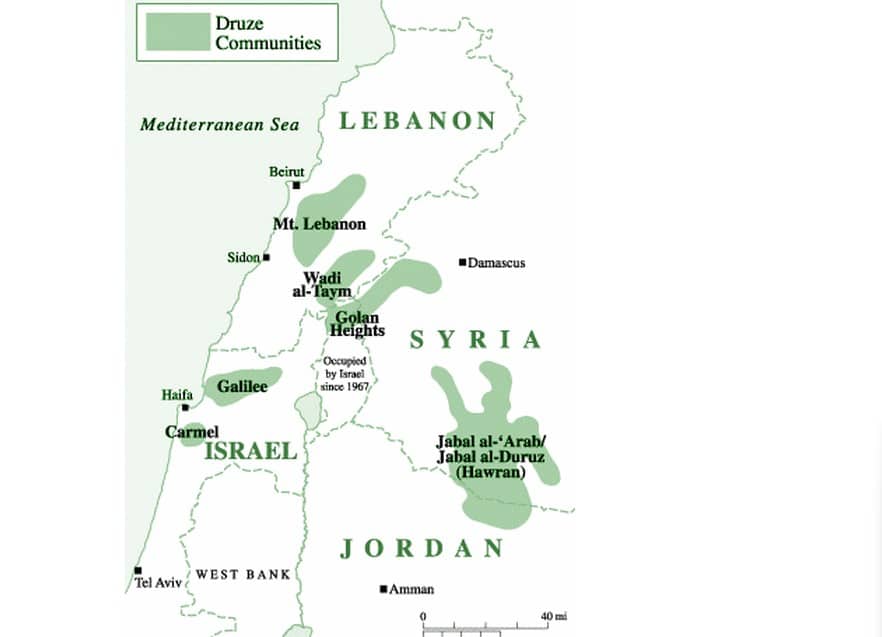
With a tightly-knit religious doctrine and disciplined social structure, the Druze have constituted a unique case in the region. From Jabal al-Arab and the Golan Heights in Syria, to Mount Lebanon, to Mount Carmel and the Galilee in Israel, the Druze have upheld the banners of land and honor, maintaining a delicate balance between preserving their distinct identity and integrating into the broader national fabric—between strategic neutrality and conditional participation in regional conflicts.
However, their influence began to wane roughly a century ago, particularly after the 1916 Sykes-Picot Agreement, which redrew the region’s borders at the expense of historical identities and organic communal ties. With the establishment of the State of Israel in 1948, the Druze suddenly found themselves geographically dispersed across three countries—Lebanon, Syria, and Israel—without feeling like first-class citizens in any of them.
From Lebanon to Israel: Diminishing Role, Eroding Influence
In Lebanon, the Druze consider themselves founding partners of the state. The Druze emirs, particularly during the Ma’anid and Shihab emirates, shaped the cultural and political trajectory of the country and laid the groundwork for religious and social pluralism—well before the proclamation of “Greater Lebanon” in 1920. However, while that declaration was a historical milestone, it ultimately diminished the Druze community’s weight, confining them to a numerical and political minority status.
The 1990 Taif Agreement—which the Druze participated in formulating after a brutal civil war—established a Christian-Muslim power-sharing formula. Yet, despite being a milestone in national reconciliation, it institutionalized a sectarian system dominated by the larger confessional blocs. Consequently, the Druze role gradually eroded, with their presence becoming increasingly tied to the strength of individual political leaders rather than to the principle of equal citizenship. Today, with growing discussions of a “tripartite” power-sharing model and shifting demographics, Lebanese Druze legitimately fear becoming followers in a country they helped build—third-class citizens after once being key decision-makers.
In Israel, following the state’s founding, the Druze chose to remain on their land and adapt to the new reality. The Israeli state granted them a distinct legal status, separate from other Arab communities, and imposed mandatory military service, aiming to integrate them into the Israeli structure. Indeed, Druze citizens of Israel gained a measure of stability and security, and many were partially integrated into state institutions—yet they never fully assimilated, maintaining their distinct identity.
Still, the Druze have never felt they were truly equal citizens. This sentiment deepened after the 2018 enactment of the “Nation-State Law,” which explicitly defined Israel as the “nation-state of the Jewish people,” effectively denying equal citizenship to non-Jews. The law enshrined Druze as second-class citizens by law, not merely in practice.
Suwayda’s Greatest Test: An Existential Threat
In Syria, the Druze were at the forefront of the 1925 Great Syrian Revolt, led by Sultan Pasha al-Atrash, fighting fiercely against French colonialism until independence was achieved. Yet, the modern Syrian state failed to reward this contribution. The Druze found themselves relegated to the margins—an overlooked minority excluded from power structures.
With the rise of the Ba’ath Party and, more significantly, the Assad family’s consolidation of power, the Druze influence further diminished. Suwayda became politically and economically marginalized, referenced by the state only when security threats emerged or pressure was needed. Despite the Druze’s distinct stance during the 2011 uprising—where they rejected armed conflict and called for peaceful, civil solutions—they were increasingly isolated and subjected to security risks from various sides.
In recent months, as Israeli discourse about potential post-Assad partitioning in Syria grows, and with talk of a provisional “Ahmad al-Sharaa government” in Damascus, the Druze have doubled down on their commitment to a reimagined Syrian state—founded on equality and full citizenship. Yet, they continue to face attacks—sometimes from extremist groups, sometimes from elements within the state itself—heightening their vulnerability and intensifying their fear of marginalization, or worse: being reduced to fourth-class citizens in their own land.
Existential Mobilization and Internal Shifts
Amid this complex landscape, notable shifts have emerged within the Druze community. There is growing disengagement from traditional political leadership and a rallying around religious authorities, who now sound the alarm, emphasizing the Druze existential cause from a survivalist—not political—perspective.
Indeed, the Druze—who have historically shown resilience in adapting to seismic regional shifts—today feel profoundly threatened. Existential mobilization has reached new heights. Communication channels between Druze communities in Lebanon, Syria, and Israel are now more active than ever. For them, the question is no longer “whether to act,” but rather: Where can we still exist?
In conclusion, this is no longer a sectarian or geographic issue—it is a comprehensive existential dilemma. The Druze, particularly in Syria, are not in a position to freely choose their path, given the immediacy and multiplicity of threats. It is therefore the duty of the Syrian state—should it wish to preserve its unity—to restore dignity to this community, ensure its security, guarantee its equal citizenship, and shield it from the destructive forces of political and security manipulation.
If not, then the state will have effectively pushed the Druze toward alternative options—options they have, until now, been striving desperately to avoid.
(Associated Medias) – Tutti i diritti sono riservati
L’articolo Nidal Shoukeir, ” What Future Awaits the Druze in the Region?” proviene da Associated Medias.