by Carlo Longo
While the Ecuadorian government violently cracks down on nationwide protests against fuel price hikes, the Meloni administration cancels part of Quito’s debt—ostensibly for environmental projects, but reclassified as national security support
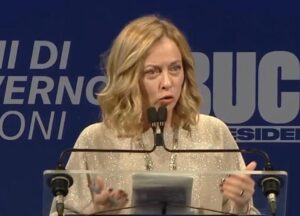 Military repression is tightening its grip in Ecuador under President Daniel Noboa, even as financial support flows in from abroad. In July 2025, the Italian government led by Giorgia Meloni signed an agreement to forgive $10 million of Ecuador’s debt. While formally allocated to environmental projects, the funds were reclassified by Rome as contributing to “national security”—raising concerns about indirect support for Noboa’s increasingly militarized rule.
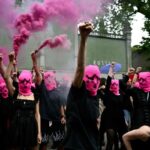
The country has been in turmoil since mid-September, when the government eliminated diesel fuel subsidies, driving the price from $1.80 to $2.80 per gallon. What started as roadblocks by transport workers quickly evolved into a full national strike, led by the powerful Indigenous group CONAIE (Confederation of Indigenous Nationalities of Ecuador), which has a long history of leading mass uprisings.
Tensions escalated dramatically on September 28, when a protester—46-year-old Kichwa community member Efraín Fuerez—was shot and killed by military forces during a crackdown in Cotacachi, Imbabura province. According to human rights group Fundación Inredh, Fuerez was struck by three bullets during the violent dispersal of protesters along the Panamericana Norte highway. A second, unconfirmed death was also reported following a motorcycle crash allegedly caused by a military checkpoint.
This is not Ecuador’s first confrontation over fuel hikes. Similar mass protests in 2019 and 2022 forced previous governments to partially or fully reverse policy decisions after days of clashes and multiple deaths.
However, under Noboa, the government’s response has been defined by the use of military force. Since assuming office, Noboa has governed under recurring states of emergency, citing threats from organized crime. In January 2024, he declared an “internal armed conflict” via Decree 111, labeling 22 domestic groups as terrorist organizations and empowering the military as a domestic security force.
The consequences have been severe. Human Rights Watch has documented instances of arbitrary detention, mistreatment, and at least one extrajudicial execution. Amnesty International has warned that “exceptional measures limiting human rights have shifted from temporary to the norm.”
The Las Malvinas case from December 2024 remains the most chilling example: four teenagers were abducted by Ecuadorian Air Force personnel in Guayaquil and later found burned and tortured. Despite Noboa’s tough-on-crime campaign promises, official records show violence has escalated—over 3,000 homicides were registered in the first three months of 2025 alone.
Amid this backdrop, the national strike continues. CONAIE has vowed to press on with protests unless the government withdraws the diesel price decree and adopts structural reforms. Despite initiating talks with Indigenous leaders and transport unions, Noboa continues to deploy troops in the streets—highlighting a deepening rift between a repressive state and an increasingly mobilized society.
As protests intensify, so does the controversy over Italy’s role. While the $10 million debt cancellation is officially framed as environmental aid, its reclassification as a national security contribution raises troubling questions. Is international aid indirectly enabling repression?
With the social climate at a boiling point and no resolution in sight, Ecuador stands on a knife’s edge.
(Associated Medias) – Tutti i diritti sono riservati
L’articolo Protests and Repression in Ecuador as Italy Forgives $10 Million Debt for “National Security” proviene da Associated Medias.