by Redazione
“How France’s struggle against radical ideologies has reshaped its society, politics, and identity.”
By Dr. Nidal Shoukeir (Professor of Strategic Communications and Governmental Relations)
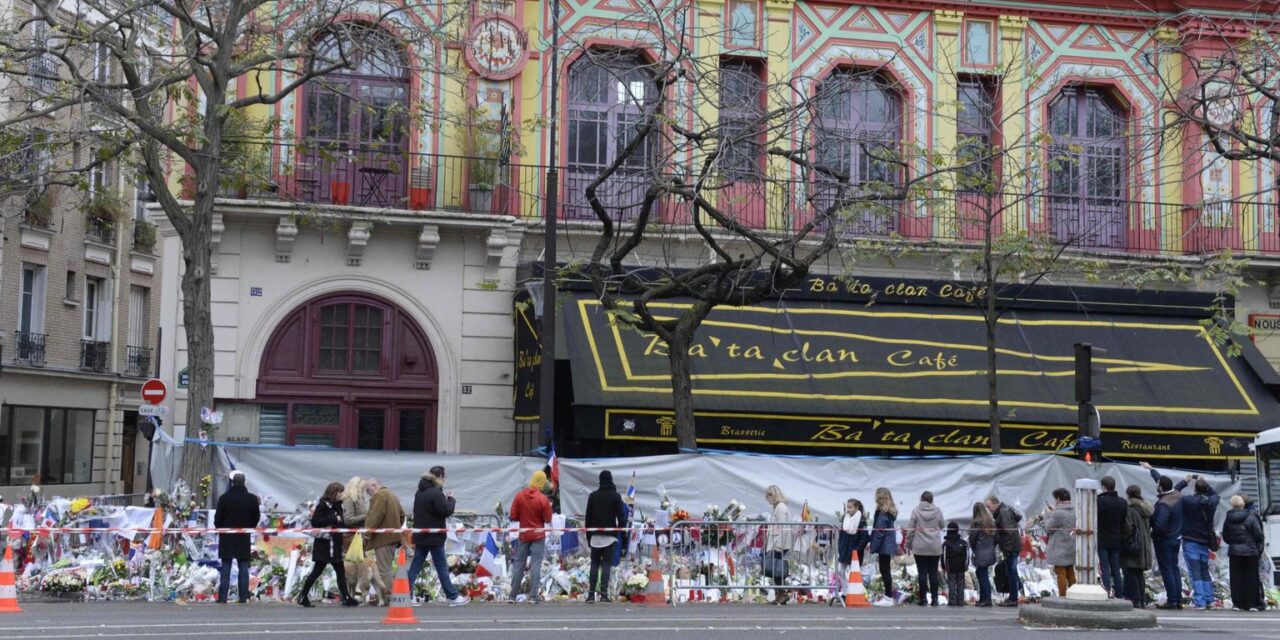
 Ten years have passed, yet the events of November 13, 2015, remain deeply etched in the collective memory and conscience of the French people. On that dark evening, Paris lived through one of the most tragic moments in its modern history, when a series of coordinated terrorist attacks spread fear across the capital and shook its very soul.Mass shootings, suicide bombings, and a hostage-taking at the Bataclan Theatre turned the “City of Light” into what resembled an open battlefield. The attacks left 131 dead and more than 400 injured, marking the bloodiest night in France’s modern history since World War II — and the deadliest in Europe since the 2004 Madrid train bombings.
A Decade of Memory and Security Vigilance
The Islamic State (ISIS) swiftly claimed responsibility for the attacks, while then-President François Hollande described them as an “act of war” against France. The country thus entered a new and prolonged phase of confrontation with what came to be labeled “Islamic extremism.”This confrontation, however, was not limited to the security and military dimensions — it soon expanded to legislative, intellectual, and societal fronts that continue to this day.A decade later, the threat remains. According to French authorities, extremist dangers persist both domestically and abroad — whether from ISIS, Al-Qaeda, or other jihadist groups. This raises a legitimate question: What is the outcome of these ten years? And to what extent has France truly succeeded in curbing a phenomenon that bears no relation to Islam or Muslims?Undeniably, France achieved rapid and tangible progress in the security field: terrorist attacks on its soil have significantly decreased, many extremist networks were dismantled, and numerous plots were foiled before execution. Yet terrorism has since evolved, becoming more individualized and sporadic, manifesting in what has been termed the “lone wolves” phenomenon.
The Intellectual and Social Challenge: A Battle Still Unresolved
On the other hand, France has been far less successful in the ideological and social dimensions of the struggle. The roots of extremism — intellectual, social, and cultural — remain largely unaddressed.In my view, this is due to five main factors:
-Communication failure — France has not effectively conveyed that its battle targets extremist groups hiding behind religion, not Islam or Muslims themselves.
-Limited inclusion — Muslim communities in France were not sufficiently involved as active partners in confronting extremism, allowing certain pockets of sympathy or tolerance to persist.
-Politicization of the issue — The fight against Islamic extremism has often been instrumentalized in electoral campaigns and partisan debates, weakening its credibility and consistency.
-Narrative vacuum — France has failed to develop a strong counter-narrative capable of challenging extremist rhetoric that thrives online and across social media platforms.
-The shortcomings of “Republican Islam” — The project of a “French Republican Islam” has struggled to take root in reality, failing to bridge the gap between state institutions and Muslim communities.
Between Security and Ideas: Toward a New Approach
If one were to describe France’s counter-extremism policies, a striking analogy would be that of chemotherapy: the treatment targets the diseased organ to eliminate the cancer, but may also harm healthy ones. Similarly, over the past decade, counter-extremism measures — though necessary — have inadvertently affected a broad segment of French Muslim citizens, aggravating social tensions.Many observers now argue that the most effective approach should resemble how we address climate change: we mitigate its dangers while simultaneously adapting to its presence. From this perspective, Islamic extremism in France cannot be eradicated entirely, but rather managed and contained as a social phenomenon through comprehensive educational, communicative, and cultural strategies.
Balancing the Internal and External Fronts
Naturally, this confrontation is far from over and will likely persist for years to come. Extremist ideologies continue to pose serious internal threats to European societies — particularly in France.A recent report by the French Ministry of the Interior (May 2025) warned of growing activity among Islamist groups, notably the Muslim Brotherhood, which the report described as employing methods of “soft infiltration” and “quiet empowerment.” Externally, jihadist organizations such as Al-Qaeda and ISIS have resurfaced in several parts of Africa, where countries like Mali, Nigeria, and Sudan have become safe havens for their renewed operations. This resurgence has reignited fears of a new wave of terrorism that could again strike Western nations — with France at the forefront.Ten years after that night which changed France and the world, it has become evident that the struggle against Islamic extremism is far more complex than a matter of security operations. It is a comprehensive battle — intellectual, social, and geopolitical — spanning both the domestic and international arenas. Within France, rebuilding trust between the state and Muslim citizens remains essential, as does fostering an open, inclusive civic culture resilient to extremist ideologies. Beyond its borders, France must maintain pressure on states and networks that support or finance terrorism, particularly in Africa where extremist groups find refuge. Ultimately, France’s success in the coming years will depend on its ability to integrate these two dimensions:
-Domestically, by establishing a human-centered, communicative model that transforms counter-extremism into a shared civic culture.
-Externally, by sustaining political and diplomatic pressure on sources of funding and support for extremist organizations.
This delicate balance will determine France’s capacity to safeguard its social cohesion, strengthen its internal stability, and sustain its regional and international influence in the face of a continuing global threat.
In the end, one question remains: After a decade of confrontation, can France truly achieve this balance between the internal and external fronts — and transform counter-extremism from a security policy into a unifying national culture?
(Associated Medias) – Tutti i diritti sono riservati
L’articolo Bataclan. Nidal Shoukeir: France and islamic extremism, a decade of confrontation after the 2015 attacks proviene da Associated Medias.