by Michael Scurry
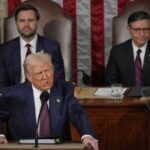
In the longest State of the Union speech on record, President Donald Trump projected confidence about the economy and wrapped his message in patriotic symbolism. Yet his combative attacks on Democrats, renewed claims of election fraud and warnings about Iran underscored a deeply polarized political climate
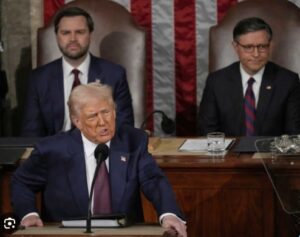 President Donald Trump opened his State of the Union address in familiar fashion: selling optimism. In a speech that stretched nearly one hour and 48 minutes — the longest of its kind — he painted a picture of a booming economy and a nation that is, in his words, “winning so much.”
“The roaring economy is roaring like never before,” Trump declared, pointing to lower gasoline prices, easing mortgage rates, prescription drug costs and a surging stock market. “Millions and millions of Americans are all gaining,” he said.
Yet that upbeat message lands against a more complicated backdrop. Public opinion surveys show persistent anxiety about personal finances, and recent polling suggests that fewer than four in ten Americans approve of Trump’s handling of the economy. While Republican lawmakers have encouraged the president to foreground economic issues ahead of the midterm elections, the contrast between official rhetoric and household sentiment remains stark.
Patriotism featured prominently in the evening’s choreography. Trump honored the U.S. men’s Olympic hockey team following their gold medal victory and presided over the awarding of the Congressional Medal of Honor to a World War II Navy pilot. The carefully staged tributes — broadcast live and designed for viral afterlife on social media — underscored the president’s instinct for spectacle and symbolic politics.
But the unifying tone proved fleeting. Trump soon pivoted to sharper attacks, blaming Democrats for rising health care premiums, affordability challenges and alleged threats to Social Security. At one point, gesturing toward the opposition benches, he accused them directly: “You caused that problem.” Later, he went further: “These people are crazy. Democrats are destroying this country.”
Such rhetoric energizes Trump’s political base, though its broader electoral appeal remains uncertain in a divided nation.
On the Supreme Court, Trump struck a comparatively restrained note. After the justices recently struck down his signature tariff policy, he had previously lashed out at the court. On Tuesday, he described the ruling as “unfortunate” but maintained that tariffs are generating revenue and strengthening the U.S. economy — a claim disputed by most independent analyses, which find that American consumers and businesses bear much of the cost.
He also revisited longstanding allegations of election fraud, asserting that “cheating is rampant” and urging Congress to require photo identification for voting. The claims echo his challenges to the 2020 election, repeatedly rejected by courts. With congressional control at stake in November, his renewed emphasis on election integrity signals a central campaign theme.
Immigration, a cornerstone of Trump’s political identity, featured heavily as well. He denounced “criminal aliens” and warned of drug traffickers and violence, though he avoided mention of controversial enforcement operations earlier this year that sparked national debate. Polling suggests a majority of Americans disapprove of his approach to the issue.
On foreign policy, Trump adopted a firm tone toward Iran, citing its regional activities and warning that it must never obtain a nuclear weapon. While expressing a preference for diplomacy, he outlined a case for sustained military readiness in the Middle East, where U.S. troop presence has expanded in recent months.
In form and substance, the address reflected Trump’s governing style: expansive, combative and heavy on spectacle. He closed with sweeping references to America’s 250th anniversary and the enduring flame of liberty, insisting, “The state of our Union is strong.”
If strength was the theme, unity was less evident. The applause lines drew standing ovations from Republicans and silence from Democrats — a tableau that captured the enduring divisions shaping American politics as the country moves toward another consequential election season.
(Associated Medias) – all rights reserved
L’articolo Takeaways from Trump’s Address: Economic Sales Pitch, Patriotic Flourish and a Sharp Turn Against Democrats proviene da Associated Medias.