by Janice McAllister
Cyprus’s president says an Iranian drone came down inside Britain’s key Middle East air hub, prompting precautionary moves for families on base and fresh scrutiny of London’s decision to let the US use UK facilities for “limited defensive” action
An Iranian drone crashed into RAF Akrotiri in Cyprus on Sunday, according to Cypriot President Nikos Christodoulides, after the UK Ministry of Defence reported what it called a “suspected drone strike” at the British base around midnight local time. No casualties were reported and the base sustained what the MoD described as “minimal damage,” but officials said family members living on the station would be moved to alternative accommodation as a precaution.
The incident comes as the UK raises its force protection posture to its highest level across the region amid a rapidly widening confrontation involving Iran, Israel and the United States. “Our force protection in the region is at the highest level and the base has responded to defend our people,” the MoD said, adding that operations continued as normal.
Administrators of the Sovereign Base Areas confirmed plans for the “temporary dispersal of non-essential personnel” from RAF Akrotiri Station, stressing the measure applied only to the military site. Residents of the nearby village of Akrotiri were not being asked to leave, and officials said surrounding workplaces, businesses and public facilities would remain open with no restrictions.
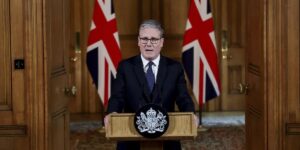
The strike allegation also landed in the middle of a politically sensitive debate in London over the UK’s role in the conflict. Prime Minister Sir Keir Starmer said Britain had agreed to a US request to use British military bases for what he described as a “limited defensive purpose.” At the same time, he insisted the UK was not involved in the initial strikes on Iran and would not join “offensive action” now—framing the decision instead as part of collective self-defence and the protection of British personnel.
European leaders reacted with pointed solidarity. European Commission President Ursula von der Leyen said she had been briefed by Christodoulides, and underlined that while Cyprus was not believed to be the target, the EU stood “collectively, firmly and unequivocally” with member states facing threats.
According to the account, the conflict escalated sharply from Saturday morning, when Israel and the US launched what was described as a “massive” series of attacks on Iran’s leadership and military, with Ayatollah Ali Khamenei reported among those killed. Iran has since fired ballistic missiles and drones at US assets and allied states across the region, with targets cited as including Israel and several Gulf countries, as well as Jordan.
British officials have warned that the risk to UK forces and civilians has increased. Defence Secretary John Healey said on Sunday that “indiscriminate attacks” by Iran were putting British troops and civilians in the Middle East in danger. He also referred to a separate earlier incident in which two ballistic missiles were fired in the direction of Cyprus, although he said he was “pretty sure” the island itself was not being targeted. A Cypriot government spokesperson later said Starmer had “clearly confirmed” during a call with Christodoulides that Cyprus was not a target.
UK forces have also been directly involved in defensive actions. The MoD said an RAF Typhoon operating from Qatar shot down an Iranian drone during a “defensive air patrol” on Sunday—the first time a British fighter has downed an Iranian drone since the current phase of strikes began. In an earlier incident, a UK counter-drone unit in Iraq brought down a drone heading toward a coalition base housing British personnel.
Behind the scenes, attention is also on which British facilities the US may use. The BBC reported that RAF Fairford in Gloucestershire and Diego Garcia in the Indian Ocean were likely to feature in US operations aimed at Iranian missile sites—an indication of how far the conflict’s geography, and the logistics of deterrence, now extend.
For Cyprus, RAF Akrotiri is not only a military asset but a symbol of the island’s proximity to Middle East conflict—and its exposure when wars spill beyond borders. For Britain, the drone crash is a tangible reminder that even “defensive” posture changes can come with immediate consequences on the ground.
(Associated Medias) – all rights reserved
L’articolo Iranian Drone Crashes at RAF Akrotiri as UK Tightens Defences Across the Region proviene da Associated Medias.