by Redazione
Securing the Strait of Hormuz is therefore no longer a policy option that can be postponed. It is both a strategic and human necessity, requiring collective action—not only to safeguard interests, but to preserve the very foundations of global stability
By Dr. Nidal Shoukeir and Dr. Mohammed Ibrahim Al Dhaheri
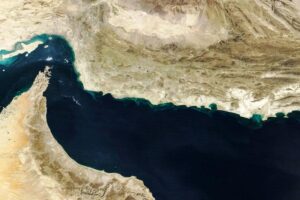
In an increasingly unstable world, the Strait of Hormuz is no longer a distant maritime passage removed from the concerns of ordinary people. It has become a vital artery—one that encapsulates the fragility of the entire international system. In recent weeks, this narrow corridor has returned to the forefront of global attention, not as passing news, but as a stark warning: the stability of the world may hinge on just a few kilometers of tense waters.
Through this passage flows not only oil tankers, but also the confidence of markets, the stability of states, and the security of societies. Any disruption—however limited—does not remain confined to geography; it spreads rapidly, reaching every household through rising prices, supply disruptions, and the erosion of economic certainty.
From Regional Passage to Pillar of Global Security
What gives this strategic corridor its singular importance today is that it reflects the limits of the world’s ability to protect itself. Between deterrence calculations and the risks of escalation, a pressing question emerges: is the international community still capable of acting in time, or has it become trapped in delayed reactions?
Securing the Strait of Hormuz is therefore no longer a policy option that can be postponed. It is both a strategic and human necessity, requiring collective action—not only to safeguard interests, but to preserve the very foundations of global stability.
Who today remains unaffected by tensions in the Strait of Hormuz? From the Middle East to Europe, from Africa to Asia, and across to the United States, no region is immune. The repercussions have already spread across the global economy, confirming that the security of this passage is no longer a regional concern, but a matter of worldwide stability.
In reality, what is unfolding in the Strait of Hormuz is no longer a local or even regional issue. It has evolved into a fully-fledged international crisis, where strategic, economic, and security interests intersect. The stability of this passage has become a defining element of global equilibrium.
A Crisis Beyond Geography: When the World Bears the Cost
First, the crisis in the Strait of Hormuz can no longer be framed as a purely Gulf issue. It is a global challenge that directly affects the balance of the world economy.
While Gulf states may appear, at first glance, to be the most exposed due to their dependence on energy exports, the strategic reality is more nuanced. Over the medium and long term, these countries possess the capacity to adapt—through diversifying export routes and developing alternative logistical solutions.
Moreover, fluctuations in energy prices, while challenging in the short term, may not necessarily translate into long-term losses for these states. By contrast, the global economy bears the heavier burden of such volatility.
Major economies, highly dependent on stable energy flows, are particularly vulnerable. Any disruption in this strategic corridor does not simply affect one region—it strikes at the very core of the global economic system, placing industrial powers under unprecedented pressure.
Reducing this crisis to a regional issue is therefore a misreading of its true nature. It is, fundamentally, a global crisis requiring coordinated international action.
From State Tensions to Human Hardship: The Social Dimension
Second, the crisis in the Strait of Hormuz is no longer merely a matter for governments—it has become a crisis affecting populations, especially the most vulnerable.
While states focus on strategic calculations, the real impact is felt in everyday life. Rising energy prices do not remain abstract market figures; they translate into inflation, eroding purchasing power and placing heavy burdens on low-income populations.
In several countries, including Egypt, Bangladesh, and Thailand, pressures on energy supplies have already led to austerity measures such as electricity rationing. Even advanced economies are not immune. Japan, despite its strategic reserves, remains highly dependent on energy imports passing through this corridor, illustrating the universal nature of this vulnerability.
Thus, a localized geopolitical crisis becomes a global social one—affecting living conditions from major capitals to the most fragile communities. Ignoring this human dimension means failing to grasp the full scope of the crisis. Securing the Strait of Hormuz is not only a strategic necessity, but a moral imperative.
A Test for the International Order: Between Law and Disorder
Third—and most critically—the continuation of the current situation without effective international intervention sets a dangerous precedent in global crisis management.
The inability to secure this vital passage is not merely a temporary failure; it signals, implicitly, that unregulated actors can impose dynamics based on coercion and disruption. If such a pattern takes hold, it risks reshaping the rules of international conduct, where the obstruction of strategic routes becomes an accepted tool of pressure.
This evolution weakens international law and opens the door to similar scenarios elsewhere. The absence of a credible collective response also sends a troubling message: that violations of international norms may carry limited consequences.
In such a context, the global economy becomes structurally vulnerable—exposed to recurring shocks that undermine confidence and erode the foundations of international stability.
A Defining Moment for Collective Responsibility
Ultimately, the security of the Strait of Hormuz can no longer be viewed as a regional issue. It is a decisive test of the international system’s ability to safeguard its own stability.
As former UN Secretary-General Kofi Annan once stated, “collective security cannot be selective.” This principle resonates today with particular urgency. Stability cannot be preserved if vital global arteries are left exposed to tension and uncertainty.
Securing the Strait of Hormuz is no longer a matter of political choice—it is a strategic and ethical necessity. It calls for collective responsibility and decisive action from the international community.
The alternative is clear: either the world succeeds in reinforcing the principles of stability and the rule of law, or it risks drifting toward a logic of fragmentation and disorder—one whose consequences will spare no nation.
Originally published in L’Opinion
By:Dr. Mohammed Ibrahim Al Dhaheri
Deputy Director General, Anwar Gargash Diplomatic Academy, Abu Dhabi Dr. Nidal Shoukeir Professor of Strategic Communications and Governmental Relations, Paris
(Associated Medias) – Tutti i diritti sono riservati
L’articolo Nidal Shoukeir and Mohammed Ibrahim Al Dhaheri, Why Securing the Strait of Hormuz Has Become an Urgent International Imperative? proviene da Associated Medias.