by Ennio Bassi
Activists denounced Russia’s presence at the art festival, accusing organisers of giving space to Kremlin propaganda while the war in Ukraine continues
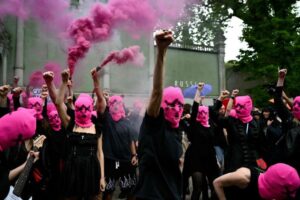 The Russian pavilion at the Venice Biennale was briefly forced to close after Pussy Riot staged a protest against Russia’s participation in the international art festival.
The action took place on the second day of the preview, when activists wearing pink balaclavas ran towards the pavilion, lit pink, blue and yellow flares and played punk music outside the building. They shouted slogans including “Blood is Russia’s Art” as visitors and police gathered around the entrance.
About 40 demonstrators took part, among them members of the feminist activist group Femen. Some attempted to enter the pavilion but were pushed back by police officers guarding the doorway. No arrests were reported.
Several activists had slogans written on their bodies, including “Curated by Putin, dead bodies included”, “Russia kills, biennale exhibits” and “Russian art, Ukrainian blood”. A statue outside the pavilion was wrapped in a Ukrainian flag.
Nadya Tolokonnikova, a founding member of Pussy Riot, led the protest. She said she had been shocked to see people celebrating at the Russian pavilion during the opening day, where prosecco was being delivered and loud techno music was playing.
“It’s weird to me that Europe keeps saying that Ukraine is a shield for the entire European continent but it opens its doors time and time again to Russian propaganda,” Tolokonnikova said. “It’s heartbreaking for me.”
The group called on Pietrangelo Buttafuoco, the president of the Biennale, to stop accepting Russian money and to meet the activists. In a statement, Pussy Riot also offered to curate the Russian pavilion in 2028, saying it would present works by artists who are currently imprisoned, or have previously been imprisoned, in Russian correctional facilities.
The protest comes amid growing controversy over Russia’s inclusion in the Biennale. According to reports, the European Commission warned the Italian government and the festival’s organisers that allowing the Russian delegation to take part could breach EU sanctions.
The political tension around this year’s event had already been high. Before the opening, the jury responsible for awarding the Golden Lion prizes resigned en masse, saying it would not consider entries from countries whose leaders were subject to international arrest warrants. That position would have excluded both Russia and Israel.
An Italian outlet later reported that the jury stepped down after being warned by the Biennale’s legal team that members could be held personally responsible if Israel chose to pursue legal action. A Biennale representative confirmed the accuracy of that report.
The UK also distanced itself from the event at government level. At the opening of the British pavilion, dedicated to artist Lubaina Himid, a representative of the British ambassador said no minister had attended because of Russia’s participation. Although the British pavilion is managed by the British Council, ministerial attendance is customary.
A UK government spokesperson said Britain “strongly opposes Russia’s participation” and stands with Ukraine after more than four years of Russian aggression.
The Russian pavilion was not the only site of protest. Later in the day, the Art Not Genocide Alliance demonstrated outside the Israeli pavilion in the Arsenale, protesting against Israel’s inclusion over the war in Gaza. The pavilion was locked from the inside as demonstrators gathered at its doors.
More than 200 participants in the Biennale have signed a letter calling for the cancellation of the Israeli pavilion, describing the demand as a refusal to give a platform to the Israeli state during its military campaign in Gaza. Israel’s foreign ministry condemned the campaign, calling it anti-Israeli political indoctrination and discrimination.
A larger demonstration coordinated by the Art Not Genocide Alliance is expected on Friday, with organisers saying Italian unions, art workers, curators and artists represented in national pavilions will take part. Some artists may create picket lines outside their own pavilions and ask visitors not to enter.
Politics has often entered the Venice Biennale. In 1968, protests linked to the wider student movement targeted the United States over the Vietnam war. In 1974, the entire event was dedicated to the people of Chile under the dictatorship of Augusto Pinochet.
This year, however, the disputes have moved from the background to the centre of the festival. The art remains on display, but the question of who is allowed to exhibit — and at what moral cost — has become impossible to ignore.
(Associated Medias) – all rights reserved
L’articolo Pussy Riot protest forces temporary closure of Russian pavilion at Venice Biennale proviene da Associated Medias.