by Giulio Talarico
From the rigour of public finances to the challenge of productivity, from the role of the banking system to investments for young people: in an interview with the Editor-in-Chief of Il Sole 24 Ore, Intesa Sanpaolo’s CEO sketches out his vision for the country and for Europe.

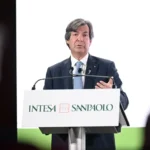
With his characteristic authority and candour, Carlo Messina tackles with pragmatism and broad vision the crucial issues of the economic phase Italy is going through, also focusing on the role of banks. In an interview with Fabio Tamburini, the CEO of Intesa Sanpaolo—who has led the group for twelve years and recently won the title of “European Banker of the Year 2024”—acknowledges the Government’s efforts to restore order to public accounts, but adds: “Rigour is fine, but now the country needs to grow.” A goal which, in his view, cannot be achieved without the contribution of the banking system and greater respect for a sector that supported the State “when bond placements went deserted.”
Exiting the infringement procedure: “A priority to tackle inequality”
Messina describes Italy’s exit from the EU infringement procedure as a crucial strategic decision: it will allow the government to free up resources and intervene “on the excessive inequalities that exist in the country today.”
The point, he insists, is not just keeping the deficit below 3%, but enabling the State to regain room for manoeuvre. In this perspective, he recalls the role of banks as allies in maintaining public debt stability: “We are the second-largest holders of government bonds after the ECB. Without our support, the State would be in far more difficult conditions.”
The banks’ contribution: “Let’s not forget what they have done”
In the most difficult years, Messina stresses, banks and insurance companies provided decisive support to public debt: buying bonds at delicate moments, backing risky auctions, and helping restore market confidence.
He recalls, for example, how in the past “the rating agencies’ assessments were negative and the spread was heading towards 500,” yet the Italian banking system ensured stability and support for bond issuance.
This is why the CEO calls for a more balanced attitude toward banks: “I expect more respect and teamwork. I don’t see why we should end up in the newspapers every day as if we were defendants.”
Looking to the future: investment and simplification
To accelerate growth, Messina believes two factors are essential:
-
Public policies that encourage investment – “We need measures that, as in the United States or Germany, support corporate investments, promote deregulation, and reduce energy costs.”
-
A major effort on administrative simplification – “We don’t need isolated measures, but an organic package.”
His vision is of a country that supports demographic growth, birth rates, the fight against tax evasion, and the recovery of the gap between North and South—pointing out that in some areas “the gap is narrowing.”
Business investment: “A 40% increase in credit isn’t enough”
In 2025, Intesa Sanpaolo increased lending to businesses by 40%, but this did not translate into a corresponding rise in productive investment.
According to Messina, the issue is not credit availability but general conditions that encourage entrepreneurs to invest in growth. “Intesa Sanpaolo is a pillar of the country, but investments must come from those who are able to make them.”
 Tax revenue and wealth tax: “Reduce inequalities, don’t fund unproductive spending”
Asked about the possibility of a wealth tax, Messina makes a clear distinction:
– he does not consider it the most appropriate solution,
– but he would be willing to contribute “if it were used to reduce inequalities and not to fund unproductive spending.”
He offers a stark observation on Italy’s fiscal profile: over 72% of Italians declare incomes under €29,000 gross—a figure that “does not reflect the real distribution of wealth.”
Human capital and technology: “Artificial intelligence risks creating a US–China duopoly”
Messina does not underestimate global challenges: technological transition is accelerating, and Europe risks falling behind.
Italy, he notes, must avoid depending solely on the manufacturing axis of Germany and France: “We need to strengthen connections with other emerging industrial areas.”
On artificial intelligence, the risk is a market dominated by a few US and Chinese giants. “We need a European policy capable of building a genuine technological hub.”
Healthcare and inclusion: “Health has become the real national emergency”
Rising healthcare costs and disparities in access to services lead Messina to identify healthcare as the top priority of the public agenda. This connects to another central theme: the dignity of the most vulnerable.
In daily work, he says, “inclusion and dignity are the priority.”
He cites Intesa Sanpaolo’s commitments:
– €64.5 million to food and shelter programmes,
– €24.9 billion in credit to support non-profits and vulnerable individuals,
– 810 innovation projects funded.
Europe and the momentum of emerging countries
Messina highlights a clear global trend: the economic centre of gravity is shifting eastward. China and India, with their demographics and innovative capacity, are becoming key players; the West must respond by accelerating industrial transition and innovation.
Part of the solution, he argues, lies in Europe’s ability to remain united: “The German temptation to reconsider foundational agreements? I don’t think it’s a viable path. Europe’s strength lies in connection, not separation.”
Intesa Sanpaolo’s industrial strategy: “Digital transformation and new skills”
In 2026, the group will present its new business plan. Messina anticipates a deep transformation based on:
– completing digital transformation,
– redesigning professional roles,
– expanding wealth management and insurance services,
– no plans for extraordinary operations in Europe.
Intesa Sanpaolo is already “the only Italian banking group close to one trillion euro in assets under management,” a capital representing enormous development potential.
 International competition and new fintech firms: “The real issue is reliability”
Among the current challenges, Messina mentions competition from companies like Revolut: agile tech operators working in financial services without being subject to the same rules as traditional banks.
He stresses that reliability remains the decisive benchmark: “We are a solid company, capable of creating value for shareholders and the community. Fintechs may grow quickly, but they are not subject to the same prudential requirements.”
View on the budget and the relationship with Germany: “Growth and investment, not austerity”
Looking at the upcoming budget, Messina warns against repeating past recessionary choices: “Italy will not regain ground without a growth strategy.” As for Germany, he reiterates: its strength does not lie in austerity, but in its ability to connect its manufacturing base with international supply chains—a model Italy can still learn from.
The interview concludes with a clear conviction: Italy can catch up, but only if growth, social cohesion, and innovation are placed at the centre of public and private decision-making. And the banking system—much more than often acknowledged—is destined to play a decisive role in supporting this trajectory.
(Associated Medias) – Tutti i diritti sono riservati
L’articolo Carlo Messina (Intesa Sanpaolo): “Italy needs more growth. And more respect for its banks.” proviene da Associated Medias.