by Martina Esposito
At the first Institutional Breakfast dedicated to India, Deloitte reaffirmed its role as a platform for dialogue between institutions and businesses. Andrea Poggi and Fabio Pompei outlined the network’s approach: objective analysis, social impact, and public–private cooperation to seize the opportunities offered by the Indian market.
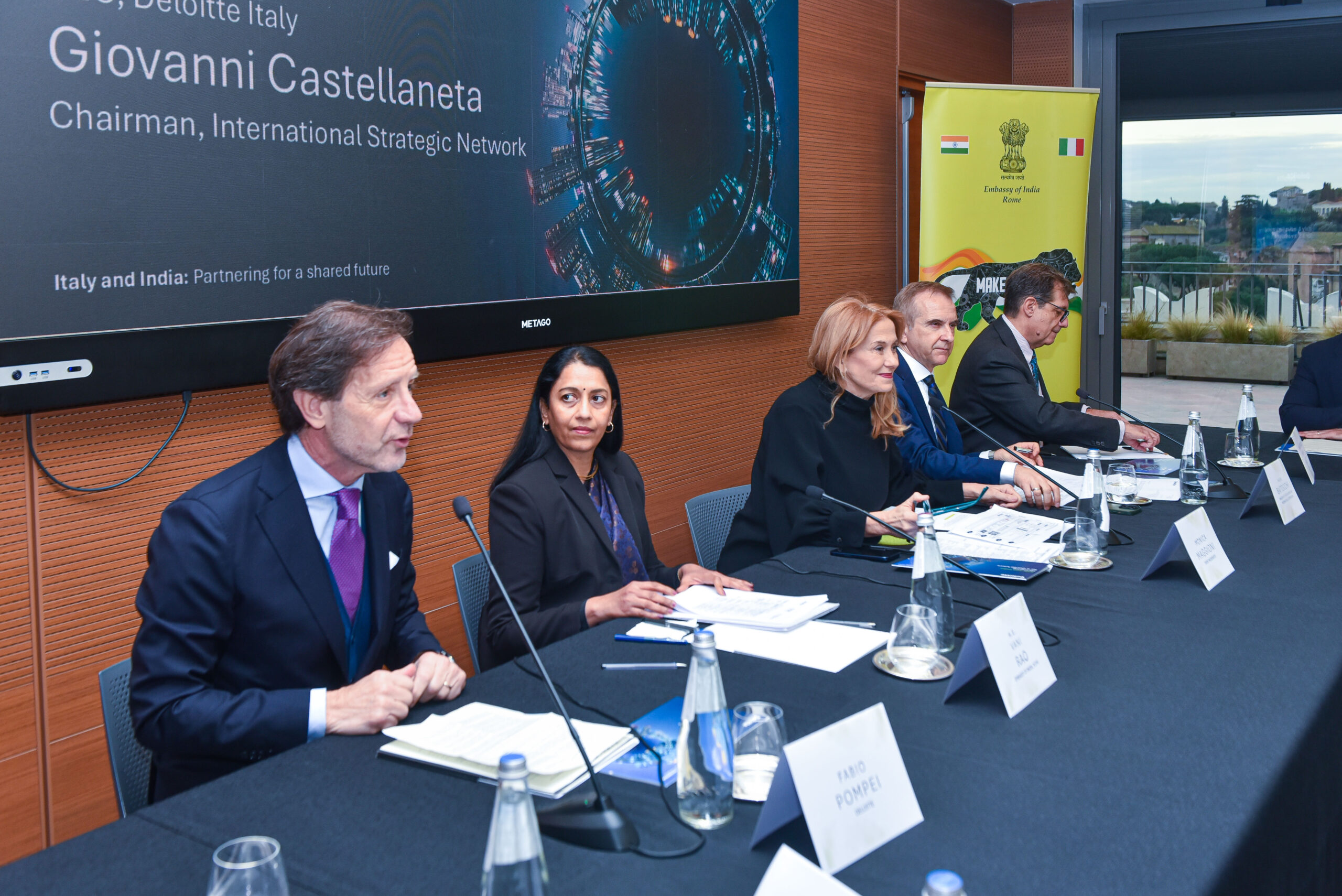
At a historic moment marked by geopolitical tensions and the redefinition of global economic balances, the first Institutional Breakfast dedicated to India—promoted by Deloitte in collaboration with ISN and AMPA—brought together institutional, diplomatic, and business representatives in Rome to strengthen dialogue between the two countries and highlight new opportunities for cooperation. Titled Italy & India: Partnering for a Shared Future, the meeting clearly underscored the central role Deloitte intends to play as a facilitator of strategic dialogue between institutions and businesses. We spoke about this with Fabio Pompei, CEO of Deloitte Italy, and Andrea Poggi, Head of Public Policy & Stakeholder Relations Central Mediterranean.
Pompei: “Italy and India Have Top-Tier Strategic Relations”
On the sidelines of the first meeting, held at the Associazione Civica venue in Piazza Venezia, Fabio Pompei outlined the key features of Deloitte’s commitment to international dialogue, particularly between Italy and India.
“We envisioned this series of meetings to build solid foundations between institutions and the business community. This is not just about talking, but about fostering lasting partnerships and creating value for society. Italy and India have top-tier strategic relations, and this moment—also in light of the upcoming EU–India free trade agreement—is a historic opportunity.”
Pompei then emphasized Deloitte’s broader commitment to supporting the economic and social development of the territories in which it operates:
“We believe that an organization like ours must play an active role in sustainable growth dynamics. We cannot limit ourselves to providing professional services: we must support businesses and institutions in making informed decisions based on data and solid analysis. Initiatives like this show that public–private collaboration can deliver tangible and lasting results, especially in a strategic context such as India.”
The CEO also recalled Deloitte’s long-standing impact-oriented approach:
“Through our Public Policy Center and the Deloitte Foundation, we promote initiatives that combine innovation, responsibility, and strategic vision. We aim to act as a bridge between economic vision and social impact, contributing to community growth, supply-chain strengthening, and the overall competitiveness of the national system.”
Poggi: “Italy Moving Toward an Increasingly Relevant Role”
Andrea Poggi, Head of Public Policy & Stakeholder Relations Central Mediterranean at Deloitte, outlined a clear and operational vision of the method Deloitte adopts to address major global challenges.
“The complexity of the global socio-economic system is extremely high,” he explained, “and it is clear that only through cooperation among all actors—businesses, governments, institutions, associations, and research centers—can effective solutions be found.”
Deloitte’s Public Policy Center was created precisely for this purpose: to establish a neutral and qualified space where public–private dialogue is guided by evidence, data, and concrete analysis.
“We provide objective data and analytical tools to enable institutions and businesses to jointly develop effective policies. Even today, during this event, we presented useful information to understand where to intervene, which barriers to remove, and how to facilitate cooperation.”
Poggi then focused on India as a key market for Italy and Europe, thanks to its growth trajectory and demographic and technological dynamism.
“We are talking about a country that has attracted over 450 billion dollars in net foreign direct investment over ten years, boasts a young and evolving workforce, and in 2024 alone recorded trade exchanges with Europe exceeding 190 billion dollars. In this context, Italy can and must play an increasingly relevant role, also thanks to its industrial excellence.”
Deloitte’s focus, he added, is to understand where and how these areas of excellence can align with the priorities of the Indian market: infrastructure, healthcare, bioeconomy, and digital services.
“Over the next ten years,” he concluded, “more than 600 million people will move to Indian cities. This represents enormous opportunities for Italian companies willing to contribute high-quality solutions to urban development, sustainable transition, and technological innovation. Our role is to facilitate this encounter by building the political, regulatory, and operational conditions needed to translate it into real impact.”
Other Key Participants in the Discussion
Moderated by RAI journalist Monica Maggioni, the event featured a high-level roundtable with several institutional and diplomatic representatives, including Ambassadors Giovanni Castellaneta and Francesco Maria Talò, as well as leading figures from the business world, among them Alessandro De Luca, Head of Public Policy and Stakeholder Relations Centre at Deloitte Italy.
Participants also included Francesca Alicata, Head of Institutional Relations at SIMEST; Massimiliano Ambra, Head of Global Business Development at FS International; Enrico Maria Bagnasco, CEO of Telecom Italia Sparkle; Lorenzo Berneri, Head of Communications at SIMEST; Caterina Bivona, Head of Transportation & Services at AlmavivA; Vittorio de Pedys, President of SIMEST; Enrico Della Gatta, Vice President Defence Market Business Intelligence at Fincantieri; Sabrina Di Giorgio, Head of Public Affairs Asia, CEE, MedLATAM, Switzerland at Generali; and Marco Felisati, Director of International Affairs at Confindustria.
Also taking part in the roundtable were Laurent Franciosi, Head of International Markets at Cassa Depositi e Prestiti; Paolo Mascarino, President of Federalimentare and Ferrero; Paolo Melone, Senior Director Marketing and Business Development at Intesa Sanpaolo; Francesco Mele, Head of Media Relations at SIMEST; Francesco Mennillo, Governance & Strategy Manager at AlmavivA; Simone Mezzedimi, Director of the Italy–India Association; Fabio Panunzi Capuano, Chief Business Development Officer at Telecom Italia Sparkle; Guglielmo Picchi, President of SACE; Silvia Vaiga Perino, Head of EU and International Affairs at FS International Spa; Paolo Roth, Director of External Relations, Communication and Research at Assarmatori; Andrea Schiavoni, Head of International Market Development at Cassa Depositi e Prestiti; and Rosario Zaccà, Head of the India Desk at the law firm Gianni & Origoni.
A Forward-Looking Meeting
The importance of economic dialogue between Italy and India was reaffirmed by institutional voices, whose remarks effectively captured the spirit of the meeting. Mauro Battocchi, Director General for the Promotion of the Italian System at the Ministry of Foreign Affairs (MAECI), recalled that “together, Italy and India represent approximately 6 trillion euros” and that the shared goal is “to exceed 14 billion euros in trade exchange and reach 700 billion euros in exports by 2027. To achieve this, India is a fundamental partner.”
The event was concluded by journalist and moderator Monica Maggioni, who emphasized to the press the importance of Institutional Breakfasts in creating spaces for dialogue among those who operate concretely in international markets.
(Associated Medias) – all rights reserved
L’articolo Deloitte Strengthens the Italy–India Bridge: Strategic Cooperation and Data to Drive Development proviene da Associated Medias.