by Janice McAllister
Joined by Lady Gaga and Ricky Martin, the Puerto Rican superstar turns the Super Bowl LX stage into a vibrant celebration of Latin culture, unity and modern America
 Bad Bunny delivered a landmark Super Bowl LX halftime show, transforming Levi’s Stadium into a pulsating showcase of Latin music, culture and political subtext, while proving once again his ability to command the world’s biggest stages. Declared “Bad Bunny Day” in California on the eve of the game, the Grammy-winning artist stepped into halftime with expectations sky-high — and largely met them.
Facing inevitable comparisons with last year’s acclaimed Kendrick Lamar performance, Bad Bunny, born Benito Antonio Martínez Ocasio, embraced the moment with confidence. His 13-minute set blended spectacle, symbolism and dance-floor energy, closing with an English-language “God bless America” and a football engraved with the phrase “Together, We Are America,” tossed into the crowd as a unifying gesture.
The performance unfolded as a vivid mosaic of Latinidad. Against a backdrop of Puerto Rican flags, palm trees and dancers portraying everyday workers — from fruit vendors to power line repairmen — Bad Bunny delivered a message of cultural pride and resilience. “The only thing more powerful than hate is love,” he declared, as Levi’s Stadium erupted.
Special guests elevated the moment further. Lady Gaga surprised audiences with a salsa-inflected rendition of Die with a Smile, while Ricky Martin appeared for a powerful performance of Lo Que Le Pasó a Hawaii. Celebrity spectators, from Pedro Pascal and Jessica Alba to Karol G, Cardi B and Roger Federer, looked on as the show unfolded like a block party crossed with a political statement.
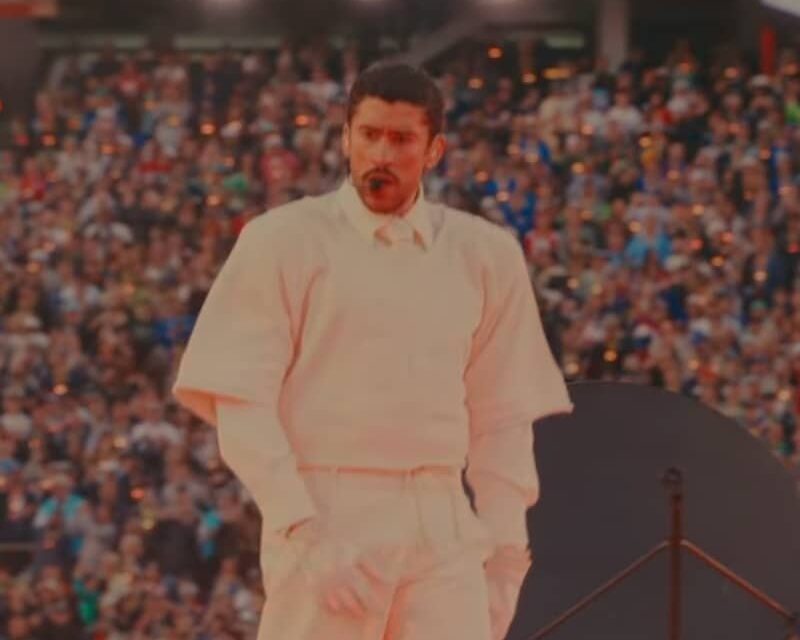
Musically, Bad Bunny powered through a high-energy medley spanning his biggest hits and recent releases, including Tití Me Preguntó, Yo Perreo Sola, Monaco, El Apagón and CAFé CON RON, seamlessly blending reggaeton, trap and house influences. Dressed in a structured white suit emblazoned with his name and the number 64, he stage-dived into a sea of dancers before shifting scenes from rural Puerto Rico to the bodegas and barbershops of New York’s Latino neighborhoods.
One of the most emotional moments came when Bad Bunny handed his Best Album Grammy to a young boy in the crowd, a gesture that resonated deeply amid ongoing debates over immigration and identity in the United States. Without overt slogans, the performance carried a clear message: dignity, visibility and belonging.
Rather than delivering a confrontational political address, Bad Bunny opted for something subtler and arguably more effective — a celebration of culture as resistance. He capped the show by naming countries across the Americas, culminating with Puerto Rico, and launching into DtMF, a chant-ready anthem that echoed through the stadium.
In an America marked by sharp political and cultural divisions, Bad Bunny’s halftime show stood out as both joyous and pointed. By centering love, movement and shared heritage, he offered a vision of the country that was expansive, multilingual and unapologetically Latin — and, in doing so, redefined what a Super Bowl halftime show can represent in 2026.
(Associated Medias) – all rights reserved
L’articolo Bad Bunny Makes Super Bowl History With a Latin-Fueled Halftime Show of Love, Rhythm and Identity proviene da Associated Medias.