
by James Crowe
With Dubai, Abu Dhabi and Doha effectively offline for days and more than a thousand flights axed in hours, hundreds of thousands of travellers are stranded worldwide as airlines brace for prolonged airspace closures and higher fuel costs.
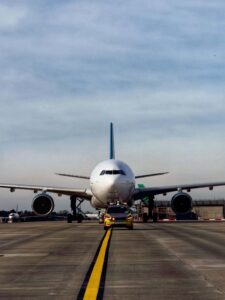
Hundreds more flights were cancelled on Monday, deepening a wave of global travel disruption sparked by the US–Israel war with Iran and leaving hundreds of thousands of passengers stranded in what analysts describe as the worst aviation chaos since the Covid-19 pandemic paralysed the industry.
The latest cancellations came as major Middle Eastern hubs remained closed for a third consecutive day, including Dubai—widely regarded as the world’s busiest international transit airport. The prolonged shutdown has rippled across airline networks worldwide, forcing carriers to suspend services, reroute flights into narrower corridors, and scramble to locate crews and aircraft now scattered across multiple continents.
By early Monday, 1,239 flights had already been cancelled, after an even more severe weekend: about 2,800 flights were cancelled on Saturday and 3,156 on Sunday, according to the tracking platform FlightAware. Airspace over Iran, Iraq, Kuwait, Israel, Bahrain, the UAE and Qatar was still virtually empty as of Monday, based on Flightradar24 data—an extraordinary blank patch over one of the world’s most heavily used aviation regions.
The impact has been particularly acute for the Gulf’s “big three” network carriers, whose hubs normally function as global switching stations linking Europe, Asia, Africa and Australasia. Emirates, Etihad and Qatar Airways have collectively cancelled hundreds of flights, while international airlines have suspended regional services and adjusted long-haul schedules.
Among the most disrupted operators cited were:
-
Emirates, which suspended all services to and from Dubai until 3pm UAE time on Monday.
-
Etihad, which halted all flights to and from Abu Dhabi until 2pm UAE time on Monday.
-
Qatar Airways, which suspended operations amid the closure of Qatari airspace.
The shutdown has also hit airlines far beyond the Gulf. Air India, for example, cancelled Sunday departures from Delhi, Mumbai and Amritsar to major cities in Europe and North America, illustrating how quickly Middle East airspace closures can unravel long-haul timetables from Asia to the West.
Industry analysts warned passengers to brace for further disruption. Henry Harteveldt, an airline analyst and the president of Atmosphere Research Group, said travellers should prepare for delays and cancellations in the coming days as events evolve. The political outlook, meanwhile, has added to market unease: Donald Trump suggested US military action could continue for several more weeks, prolonging the uncertainty that airlines and insurers struggle to price.
As the conflict widened to Lebanon—with Israeli strikes reported on Beirut’s southern suburbs after rockets were launched by Iran-aligned Hezbollah—much of the region’s airspace remained closed or heavily restricted. Airports in Abu Dhabi and Doha were described as shut or operating under severe limits, tightening the bottleneck at precisely the moment airlines need flexibility to reposition equipment.
The operational headache extends beyond passengers. Crew rosters have been thrown into disarray, with pilots and cabin staff ending up in unexpected cities after diversions, cancellations and emergency schedule changes. Even when airspace reopens, restarting a global network is not as simple as flipping a switch: aircraft must be in the right place, crews must be legal to fly under duty-time rules, and maintenance schedules must be restored.
Stranded travellers have reported difficulty obtaining timely information, crowding terminals and call centres at some of the world’s busiest airports from Bali to Frankfurt. Meanwhile, the crisis has exposed a stark divide in options: the ultra-wealthy have increasingly turned to private aviation. Ameerh Naran, chief executive of private jet brokerage Vimana Private, said Saudi Arabia had become the main exit route for those trying to leave the region, with private jet flights from Riyadh to Europe costing as much as $350,000, according to comments reported by Semafor.
Markets have taken notice. Airline shares in Asia fell as investors weighed the potential hit to demand, scheduling reliability and costs: Japan Airlines dropped 5.6%, Singapore Airlines fell 4.5%, Qantas slid 5.4% and Cathay Pacific eased 2.9%, according to the figures cited. The shock is also colliding with a familiar vulnerability for aviation—fuel prices. Brent crude rose sharply, and analysts warned that if oil pushes toward $100 a barrel, carriers could face another wave of pressure just as they grapple with mass disruption.
Even flights that continue to operate are being forced into longer routings to avoid restricted skies. Middle Eastern overflight corridors had already been reshaped in recent years after the Russia–Ukraine war pushed airlines away from certain routes; now, closures across the Gulf are compressing traffic into fewer lanes. Flightradar24’s Ian Petchenik warned that the main commercial aviation risk is sustained disruption—days or weeks of uncertainty that would strain airlines, airports and travellers alike.
For passengers, the immediate reality is blunt: missed connections, unexpected layovers, rising fares on remaining seats, and a constantly shifting patchwork of rebookings. For the industry, the deeper fear is that a temporary shock becomes a prolonged shutdown—turning a regional war into a global logistics problem in the sky.
(Associated Medias) – all rights reserved
L’articolo Flight Cancellations Surge as Iran War Shuts Gulf Skies, Triggering Worst Travel Disruption Since Covid proviene da Associated Medias.