by Jerome Lagersie
Local elections confirm Socialist dominance in key urban centres, while far-left and far-right forces advance on the margins ahead of the presidential race
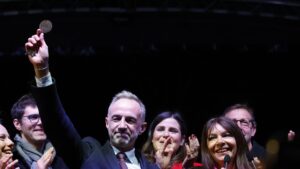 France’s Socialist Party and its allies have maintained control of the country’s largest cities, including Paris, Marseille, Lyon and Lille, in municipal elections that offered renewed momentum to mainstream political forces ahead of the next presidential contest.
In the capital, Emmanuel Grégoire secured victory to become Paris’s new mayor, succeeding Anne Hidalgo, who chose not to seek a third term. His win, widely anticipated, reinforces Paris’s longstanding inclination toward left-leaning leadership, shaped in recent years by policies such as restrictions on car use that have broadly resonated with voters.
Across the country, the results painted a more nuanced political landscape. While mainstream parties largely held their ground in major urban centres, both the far-left France Unbowed (LFI) and the far-right National Rally (RN) made notable inroads elsewhere. LFI claimed success in Roubaix, while an ally of Marine Le Pen triumphed in Nice, highlighting the continued appeal of more radical platforms beyond metropolitan strongholds.
A key takeaway from the الانتخابات was the mixed—and often counterproductive—impact of alliances between the Socialist Party and the far-left. In several cities, including Clermont-Ferrand and Brest, such cooperation appeared to alienate moderate voters, benefiting centrist and conservative candidates. Conversely, where Socialist incumbents distanced themselves from LFI, as in Paris and Lille, they were more decisively returned to office.
Lyon stood out as an exception. There, Green mayor Grégory Doucet retained power despite aligning with LFI, a result many observers attributed to a weak campaign by his conservative challenger rather than the strength of the alliance itself.
Tensions surrounding LFI also shaped the campaign. Controversies involving party figures and remarks by its leader Jean-Luc Mélenchon fueled criticism and led some Socialist figures to call for a boycott. Nevertheless, electoral pragmatism led to last-minute alliances in several races—often with disappointing outcomes.
On the right, the National Rally demonstrated its resilience, particularly in smaller towns such as Montargis and Carcassonne, even as it fell short in larger targets like Marseille. The emergence of a more unified right-wing bloc was evident in Nice, where Eric Ciotti’s victory was interpreted as a sign of shifting dynamics within conservative politics.
Centrist forces aligned with President Emmanuel Macron also found reasons for optimism. The Renaissance party secured a significant win in Bordeaux, while former prime minister Édouard Philippe reclaimed Le Havre—an outcome that strengthens his potential candidacy in the 2027 presidential election.
Overall, the الانتخابات underscored a fragmented but stabilising political environment. While extremist parties continue to gain ground in specific क्षेत्रों—urban peripheries for the far-left and provincial المناطق for the far-right—the mainstream left, right and centre collectively emerged as the dominant force.
Yet uncertainties remain. The الانتخابات result suggests that traditional parties could prevail in a head-to-head presidential runoff against an extremist candidate. However, a scenario in which both finalists come from the political extremes remains a source of concern within France’s political establishment.
(Associated Medias) – all rights reserved
L’articolo French Socialists Retain Major Cities in Vote Seen as Boost for Mainstream Politics proviene da Associated Medias.