by Jack Diffley
Leaders agree to pause export curbs on rare earths and semiconductors, ease tariffs on fentanyl and shipping, as both sides seek to reduce tensions after years of economic strain.
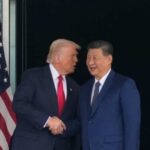
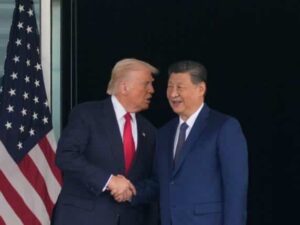 In a significant development aimed at cooling tensions between the world’s two largest economies, the United States and China have agreed to a one-year trade truce after talks between former President Donald Trump and Chinese President Xi Jinping in Busan, South Korea. The agreement includes the suspension of key export controls on rare earth minerals and semiconductors, alongside mutual tariff reductions.
The summit marked the first face-to-face meeting between the two leaders in six years and produced what Trump described as “an outstanding group of decisions.” Among the key takeaways, Beijing will halt its export restrictions on rare earths—materials critical to global tech and defense sectors—while Washington has agreed to delay an extension of its own export controls targeting Chinese tech firms.
“This was an amazing meeting. On a scale of 0 to 10, it was a 12,” Trump declared aboard Air Force One, emphasizing that the accord would be reviewed annually but is expected to last well beyond its initial one-year term.
The truce also addresses long-standing disputes over fentanyl and shipping tariffs. Trump announced a cut in fentanyl-related tariffs on China from 20% to 10%, following a commitment from Xi to intensify efforts to curb chemical exports linked to opioid production. This brings the average tariff on Chinese imports to 45%.
Additionally, both nations agreed to lift retaliatory tariffs on their respective maritime and logistics sectors. The US will suspend new port fees imposed on Chinese shipping and shipbuilding industries for one year, while China will pause its countermeasures on US-linked vessels.
China’s Ministry of Commerce confirmed the mutual suspension of measures and indicated further collaboration in areas such as agricultural trade, fentanyl control, and company-specific disputes. It also confirmed that Beijing will work with Washington on resolving ongoing issues surrounding the Chinese-owned social media platform TikTok. Trump noted that China had agreed to cede operational control of TikTok in the US to American stakeholders.
Notably absent from the talks was any discussion of Taiwan, despite speculation that it might be used as a bargaining chip. “Taiwan never came up. It was not discussed,” Trump clarified.
Xi, as reported in Chinese state media, urged both sides to implement the consensus reached and to begin refining follow-up measures immediately. However, he did not publicly confirm the specifics of the deal.
The Busan summit, held on the sidelines of the Asia-Pacific Economic Cooperation (APEC) forum, lasted approximately 90 minutes. The cordial tone between the leaders was evident, with Trump calling Xi “a great leader of a great country,” and Xi acknowledging that it is normal for two major powers to experience periodic friction.
Trump also revealed that both countries are in talks for a substantial oil and gas deal involving resources from Alaska, though details remain scarce. He is expected to visit China in April, with Xi scheduled for a reciprocal trip to the US.
While some experts praised the agreement as a path toward more comprehensive negotiations—potentially led by US Treasury Secretary Scott Bessent and his Chinese counterpart He Lifeng—others expressed skepticism.
“Xi stared down Trump and Trump blinked,” commented Scott Kennedy, senior adviser at the Center for Strategic and International Studies (CSIS). “Xi has mastered managing Trump. Meeting US threats with larger threats has gotten Washington to back down.”
Financial markets remained largely unmoved by the news, with US stock futures and Asian equities holding steady or slightly lower.
(Associated Medias) – all rights reserved
L’articolo US and China Seal One-Year Trade Truce Following Trump-Xi Summit in South Korea proviene da Associated Medias.